

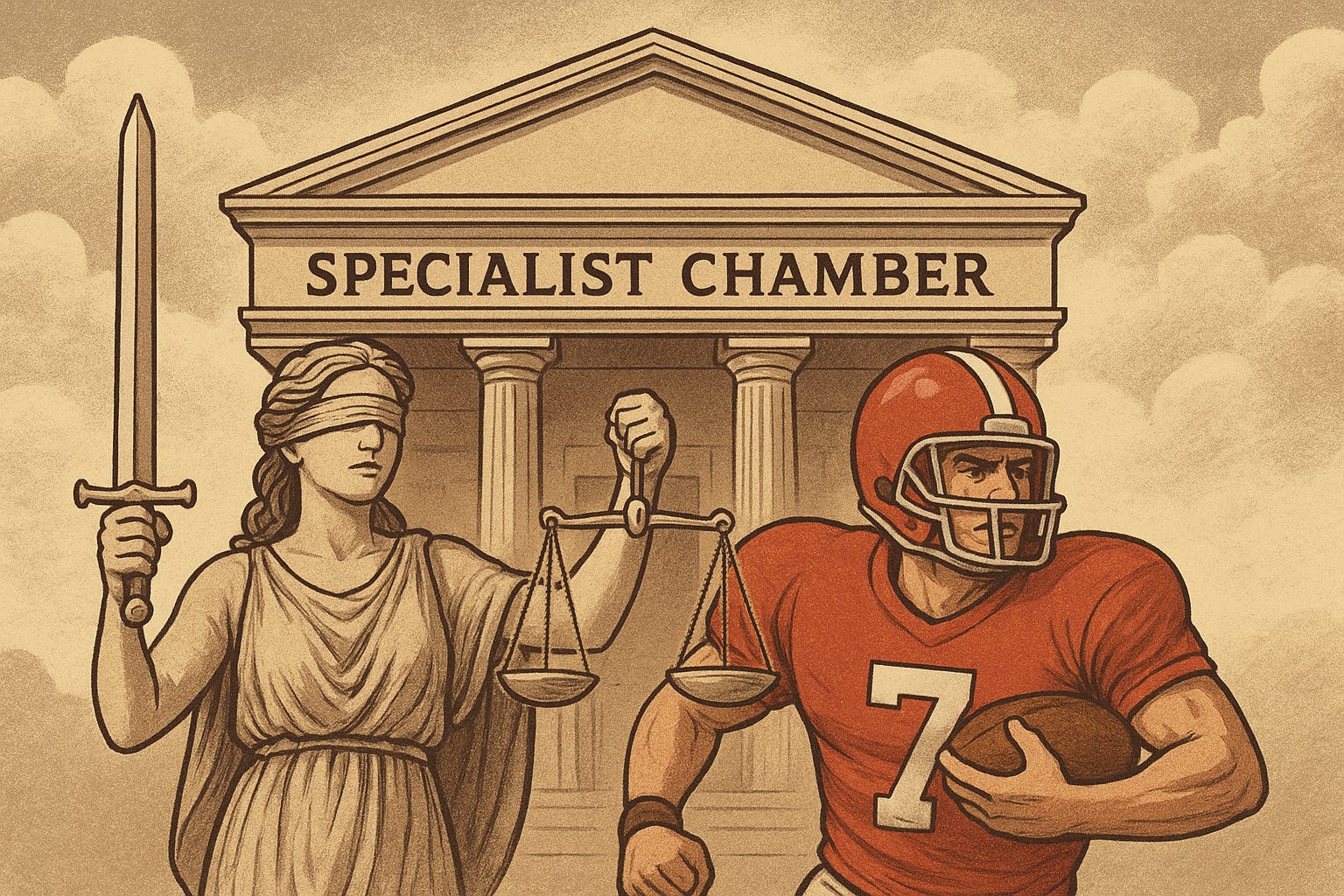
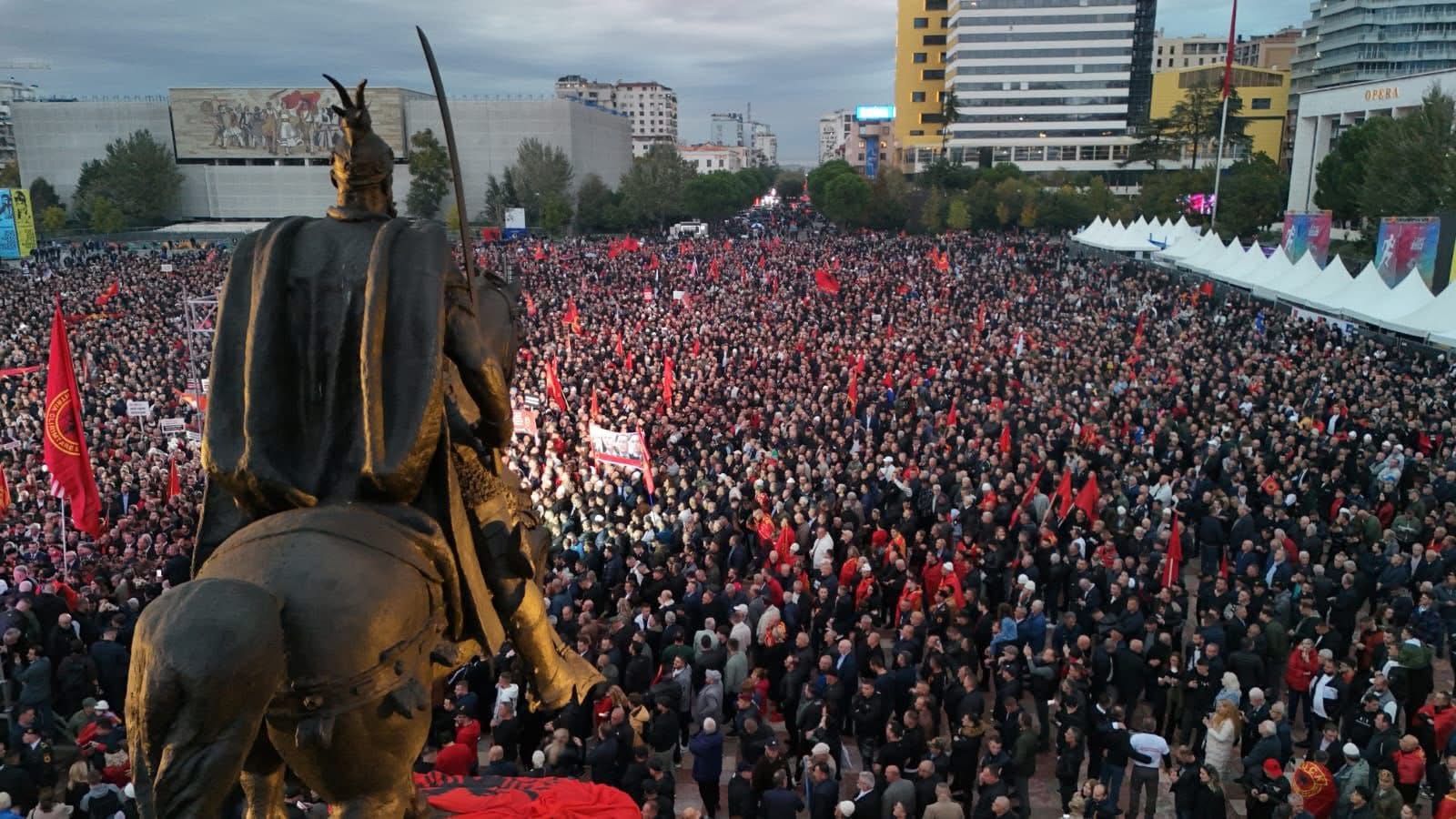
Tens of thousands of Albanians, led by the veterans’ organizations from Kosovo, protested last week against the “grave injustice” unfolding at the Specialist Chambers prosecuting the co-founders of the ragtag guerrilla army that started the uprising against Milosevic regime.
Albania’s Prime minister Edi Rama as well as key Albanian leaders from Balkans endorsed strongly the protest, with few notable exceptions: the President and the former Prime minister of Kosovo stayed mostly silent. As matter of fact, the former ruling party Vetevendosje of the acting Prime minister Kurti published a harsh statement insinuating that Hashim Thaçi brought this upon himself, that he supported the creation of the Special Court and therefore has no one to blame for being indicted by it. It’s a convenient narrative, one that allows VV to claim prophetic foresight for which Kurti is famous: I told you so. But it’s also a cynical distortion of history, and a perfect example of how Kurti’s permanent state of righteousness can rot into historic revisionism.
VV’s claim of course reminds us of Gospel of Matthew (26:52), where Jesus tells Peter: “Put up again thy sword into his place: for all they that take the sword shall perish with the sword.” It’s one of the most quoted Biblical references and reflects well VV’s intended message to Albanian public, parroted incessantly by VV apparatchiks and their army of trolls across social media. But it’s a fallacy. A dangerous fallacy.
The context VV chooses to forget
Few years ago, Dr. Nevenka Tromp, an experienced war crimes researcher and investigator at The Hague Tribunal (ICTY) gave a lecture which outlines well the context when and how the Specialist Chambers were established:
“The frequency of the appearance of President Thaci’s name in the Dick Marty report indicated that the authors of the report - and those who were feeding the information to the authors - were aiming at the creation of a specialist court and that President Thaci could most probably be one of the indictees. Paradoxically, the court could be formally established in 2015 only after Hashim Thaçi pushed hard to lobby the parliament for the amendment to the Kosovo Constitution that would allow that a court of such format be outplaced to The Hague. This did not contribute to President Thaci’s popularity amongst his fellow Kosovars. The opposition used it in the political power struggle against him and his party… This discourse of a “bargain went wrong” casts President’s Thaci’s role in the formation of the court - as his leadership’s weakness.”
So, let’s be clear: the Special Court was not some sort of President Thaçi’s pet project. It was a product of geopolitical coercion, a blackmail even. In 2015, then–U.S. government applied immense pressure on Kosovo leaders and Members of the Parliament to establish the court, as a response to Dick Marty’s organ harvesting allegations. Assistant Secretary of State Victoria Nuland made an unambiguous threat - if Kosovo refused to create its own tribunal, the United Nations would impose one, but Kosovo’s “relationship with the international community would also be put on hold”.
The choice for Thaçi and the governing coalition of PDK-LDK at that time, therefore, was not between having or not having a court, but between a Kosovo-led process or one led by the UN under Resolution 1244. Key allies of Kosovo in the US, from then Vice President Biden to Chairman of Foreign Affairs Committee in US Congress, Rep. Eliot Engel, to former Senator Bob Dole gave a clear message to Thaçi et al.
President Thaçi, Prime minister Mustafa and their government chose to safeguard Kosovo’s alliance with the USA. It was not some sort of a moral or ideological stance; it was a strategic concession. By taking ownership of the process, Kosovo preserved at least a fragment of its sovereignty and preserved relationship with the USA. Today’s VV’s rhetoric erases that reality entirely, pretending as though Thaçi willingly invited foreign judges to dismantle his own legacy.
Dr. Tromp proposed, in the same above-mentioned lecture held in Prishtina (which was unsurprisingly boycotted by VV) invites observers to see the creation of the Special Court from a different angle:
“Another discourse interprets the role of President Thaci in the creation of the KSC as his leadership’s strength. It goes like this: President Thaci, understanding the risks that once the court is there, he would be most probably indicted himself, he put the long-term strategic interest of Kosovo before his own personal and professional interests.”
Strawmen and False Dilemmas
This is VV’s specialty: simplifying the complex issues to claim moral victory based on a populist discourse of moral absolutism, this all propagated with a Robespierrian vigour. By portraying Thaçi’s decision as a personal betrayal of Kosovo, they build a strawman they can easily burn down. In VV’s binary world, there are only two choices: total resistance (which they would have heroically led now, despite being less than eager to fight when it mattered in 1999) or total surrender to American interests.
But I repeat, this is a fallacy. A textbook false dilemma. Refusal was never a clean or a safe option for Kosovo. It would have triggered the very outcome US government warned us about: a UN-imposed court, completely outside Kosovo’s control. VV’s moral absolutism pretends that such real-world tradeoffs don’t exist, that politics can be conducted as a purity contest.
This kind of rhetoric works well for populist rallies and Facebook posts. It flatters the faithful, frames the past as a simple morality play, and permanently and perpetually absolves VV of ever having to explain the cost for Kosovo had the Parliament refused to approve it.
Benefit of the handsight
There’s a great American phrase “Monday-morning quarterbacking”. It comes from American football culture: games are usually played on Sunday, so on Monday mornings, fans of the losing teams are always discussing what the team’s quarterback should have done differently. We have all engaged in such an exercise, in football or life, but Kurti excels at it in our political landscape.
It’s always easy to judge the past when you know how the story ends. But in 2015, the outcome was far from clear. Thaçi, Mustafa and those leaders who accepted the court faced not a choice between good and evil, but between bad and worse: between losing control of Kosovo’s judicial process or risking backlash by creating a domestic legal framework under international supervision.
At that time, no one could have been aware that a certain politicized American prosecutor Jack Smith would pervert the course of justice not by stating the obvious: there is no evidence that KLA engaged in organ harvesting conspiracy in a desolate “Yellow House” and sold body organs via NATO-controlled Tirana Airport in 1999 - but by starting an unwieldy, never-ending process claiming Thaçi was an undisputed military leader of the entire KLA, claiming that this rural guerrilla was actually a super-organized “joint criminal enterprise” hellbent to kill Albanian Catholics, Serbs, LDK members, in an organized fashion and by design.
Daniel Serwer, a former US diplomat and a well-known observer of Balkan politics writes in a recent column titled “A tribunal that has gone astray”:
“I never imagined the “Specialist Chambers” would do what it has done. In 2020, it indicted Hashim and three of his KLA colleagues for constituting a “joint criminal enterprise” that committed war crimes and crimes against humanity, not including the organ trafficking allegations…There is a lot wrong with this picture, or more accurately my view of this picture. First is the bait and switch. The Kosovo parliament believed, as I did, that the main focus of the tribunal would be the organ-trafficking allegations. The defense team has argued this point in court and lost, because there are some other allegations in the Marty report. But to a layman–that’s me–if you want your customer to be happy you don’t sell one thing and deliver another. Of course the tribunal has no reason to care much about me as a customer, but I am one. Tribunals of this sort are supposed to deliver justice, not retribution based on deception.”
VV’s “we told you so” narrative is nothing more than hindsight disguised as prophecy by the Dear Leader. It assumes omniscience that no one, least of all, a parliament of a small state under pressure, could have had. And it ignores the burden of leadership: decisions made in the fog of uncertainty, not in the clarity of commentary.
Perishing by the sword
So, in the Gospel’s warning, those who live by the sword perish by it.
VV’s sword is moral absolutism, in all manners of political decision-making, from the debate on Special Court, to the dialogue with Serbia, always propagated with a certain Robespierrian vigour, . Yet, this particular brand of resultless populist rhetoric is now turning against them. This black-and-white worldview may serve vicious partisan attacks, but it impoverishes Kosovo’s political discourse. It impoverishes Kosovo of allies. It poisons relations between Albanians as well as Albanians and others. By reducing complex history, difficult decisions in diplomacy, economy or politics to personal blame-game, VV betrays the very intellectual honesty they claim to espouse.
The decision of Kosovo Parliament and Thaçi himself to establish the Special Court was not some heroic act but it certainly wasn’t cowardly either. It was pragmatic: an imperfect choice made under pressure and threats, within the limits of a small state trying to survive the demands of its most powerful allies who have played a key role in liberation and independence. VV’s refusal to acknowledge that complexity isn’t moral clarity; it’s moral laziness, if not worse.
Politics, like faith, demands humility. And those who insist on swinging the sword of righteousness at every opponent may soon find that history, too (and the popular vote in elections), has a sharp edge.